
For who I imagine to be the modal reader finding this website, this may be a useless article. But, perhaps you’ve been linked here by a friend, found it shared on social media or stumbled upon this in any myriad of ways one finds media in the digital world. If you’re someone who wants a better understanding of what capitalism is, what socialism is, what communism is and/or wants a better understanding of the goals of a socialist then this article is for you. Socialism is far more than the scary word the American media has made it out to be over the last hundred years, or so. And maybe by the end of this article you will count yourself among our number.
Capitalism
Socialism is inherently anti-capitalist. So before we discuss exactly what socialism is we should take a minute to quickly define what it lies opposed to. Capitalism is an economic system based on the private ownership of the means of production and their operation for profit. Capitalism is a system in which someone can own something that serves the purpose of making other things in order to trade those good for the further means of making and obtaining more goods. You use stuff that gets you more stuff for the purpose of being able to acquire more stuff. Let’s give an example.
A factory on its own is of little intrinsic value. The factory itself is simply only worth the land it takes up and maybe the value of the bricks, wood and glass that comprises it. But the factory becomes worth more when the factory is able to make things. When you add machinery, raw materials, infrastructure etc. to the factory the factory is now worth more than simply the building and the land. But still it is worth more than the sum of its parts. Intrinsically, the factory is worth exactly the market value of each item within it, but in a system based on the need to create profit the factory is now worth the potential of whatever it can create. This is why companies can be valued at several times their actual profit/revenue numbers.
So this factory can produce x number of shirts using y number of materials in z amount of time via some # of workers and hours worked. The capitalist, the owner of the factory and tools, is responsible for acquiring all of these raw materials, the upkeep of the building and machinery, the employment of the workers and the sale of the finished products. The capitalist has some amount of money that necessitates the budgeting of this process. The capitalist must buy the raw materials for a cost that allows money left over for the procurement of machinery, maintenance of that machinery, maintenance of that building, pay for the employees and any other related costs prior to the sale of the finished good. Then, with all of those costs in mind, the final step for the capitalist is to do the math that determines the final sale price of the finished the good that will allow the capitalist to recoup money spent on all of the associated costs of manufacturing the finished good and to provide extra money that the capitalist can use for themselves.
Now where capitalism goes awry is in this value-added process. The fact that at any given time these items are worth more than the actual sum of their parts. Each tool is worth more than just what makes the tool, but rather what the tool is made of and what the tool can make. That each finished product is not worth simply the cotton, time and workers it took to produce it but it is worth more than that. The increased value is simply to allow the capitalist to profit off of the labor without providing value themselves. We’ll explore this more in a minute. The first thing to understand is that any commodity in a capitalist system has an intrinsic value and an extrinsic value. That is every item is worth both what it is made up of explicitly but is also worth what it can be used for. But then there is a third value for each item and that is its market value. What it can be sold for. While all three of these things are directly related none of them directly affect each other. Each item carries three separate values that are clearly intertwined yet entirely distinct. This is an inherent contradiction within all commodities in a capitalist system, and capitalism is riddled with these sorts of contradictions.
The Problem with Capitalism
A half pound of clay is worth x-amount. So it stands to reason that a bowl made from a half pound of clay would also be worth x-amount. But the half pound of clay itself is worth less than the clay bowl because the half pound lump of clay can do comparatively less. Perhaps it can be used to hold open a door or as a paperweight. But the bowl can also serve these same functions in addition to being able to hold things. The bowl can hold fruit or water or any variety of bobbles. The utility the bowl extrinsically, gives it more value than what it is worth intrinsically being a half pound of clay. But where did this worth come from? The bowl is only extrinsically worth something because it is relational to human beings. The bowl had to be transformed from raw material into a finished product by a human and now has extrinsic value due to being useful to humans. Its market value then is the value other humans are willing to part with in order to acquire the bowl as opposed to making one themselves. Perhaps one human prefers blue bowls to red bowls and thus finds a blue bowl worth more than a red bowl. This is the market value process but again the value-added to the bowl at this stage is only added in relation to human beings.
A fundamental issue in capitalism is that the relational nature of commodities becomes less about the relations of humans and the relations of commodities to other commodities. Keep this in mind as it is something we will come back to again. So what happens when we make bowls on an industrial scale? What if it is no longer one bowl maker crafting bowls individually to give to individuals in need of bowls?
Let’s go back to our capitalist factory owner and let’s imagine that, that factory is a bowl making factory. The capitalist then needs to acquire clay as a raw material to make bowls. They have an incentive to maximize profit, the fundamental goal of the capitalist mode of production, so in order to do so they need to make many bowls as efficiently as they can. Efficiency being defined as the maximum number of bowls made at the minimum possible price to meet the maximum sale price the market will accept. Make lots, as cheap as you can to sell as much as you can for as much as you can. So the capitalist acquires machinery that can quickly mold clay bowls, quickly bake these bowls, quickly finish these bowls and then package them for sale. Yet, where does the value in the product come from? Is it from the work of the capitalist? No. It is from workers.
The clay is mined from some land and transported to the factory by sets of workers, not by the capitalist who owns the mining operation or by the capitalist who owns the bowl factory. However, the factory capitalist must buy the clay at a price that allows the mining capitalist to make profit. Then the factory capitalist needs to acquire and maintain the various machinery that allows to bowl to become a finished product but at each of these steps also acquires them from other capitalists at increased prices. But, as we discovered in the single bowl example, the value given to these bowls is inherently within the labor required to create them and their future worth to other humans. The factory owner does not partake in this labor, instead only facilitating this process. The factory owner never adds to the value of the product.
Yet, at the end of the production cycle it is the capitalist who consumes the profits. Despite adding no value to the product the capitalist is the sole recipient of the final value of the bowls. Worker expenses are subsumed into the cost structure the same way the molds or kilns are. The workers are to the capitalist what a hammer or sickle is to the worker. The capitalist is under no obligation to provide the workers or the workplace with the excess values and the capitalist does not merely take some set salary in-line with worker pay. The capitalist retains all profit accrued and uses it as they see fit. This encourages capitalists to maximize profits so they can maximize their gains even further. This includes paying workers less, using cheaper materials, using cheaper tools, selling for higher prices. There are of course market demands on all of these elements that somewhat constrain capitalists from being impossibly predatory but all capitalists have the same incentives regardless. What this creates is a race to the bottom. Whoever can make the most for least and sells the most wins the battle and at some point there is an inevitable finite limit to how cheaply you can construct things.
Returning to our bowl factory, let’s say as things stand the factory employs three workers who make ten bowls a day for a total, all-encompassing, cost of $3 per bowl. This means the factory owner must sell each bowl for more than $3 in order to make a profit for themselves. For the sake of the example, let’s say the market value for a single bowl is $5. The workers need to be paid at a rate that allows them to have enough money to buy bowls. While this specific factory owner does not need their own employees to buy the bowls they make, specifically, workers must make enough money in order to buy these goods in a general sense in order to keep factories open. So the wages provided must allow for employees to pay for their basic needs and still have enough to purchase finished products. This sets a pseudo-floor on wages and a pseudo-cap on goods, hence why the bowl has a specific market value.
However, our capitalist does not have to be content to sit on their hands making $2 profit on each bowl. Capitalism breeds innovation after all, or so it is said, so in a competitive market other bowl makers will always be looking for an edge. A rival bowl manufacturer has figured out a way to now make eleven bowls per day instead of the ten our factory makes. This means the rival bowl manufacturer can now make $22 in profit daily as opposed to our factory owner’s $20 profit daily. Over time our factory owner will be left in the dust unless we can come up with some innovation ourselves. Our factory owner discovers a way to lower costs, yet the market rate remains the same. So our factory produces still the same ten bowls a day but at $2 a bowl meaning we can now make $30 profit daily. Our capitalist decides they need a bigger edge so they dip into some of that profit to hire an additional worker. Our factory now employs four workers who can make 15 bowls a day at $2.50 cost and sells them for $5 each as opposed to the rival factory who only makes eleven bowls each day at $3 cost and a $5 sale price. This means our factory makes $37.50 each day in profit yet the other factory only makes $22 in profit.
Now this is essentially an example of capitalism at its best. Innovation has lowered the cost of the bowls allowing the factory to hire more people without increasing the cost to the consumer. Assuming we have not increased the wages we provide to our employees, our capitalist now makes more money than ever and employs more people than ever but manages to actually pay them less money as a proportion of profit than they had before. Productivity is increased, we make more bowls. Costs have lowered, we pay less per bowl. We pay more in wages overall, hired an additional worker, but the ratio of pay per bowl produced is lower as is the ratio of wage and profit. Our capitalist makes more money than before yet our employees do not.
Continuing our race for efficiency there will inevitably be finite points in which tools cannot be acquired for less money nor can raw materials be acquired for less money. After all our factory owner has to purchase those from other capitalists in charge of mining and tool manufacturing. The speed at which an individual worker + their tools can turn out a bowl will likely reach a point that it cannot be further accelerated. Innovations in tools that do make things faster will likely come at a cost increase versus the tools our factory owner already possesses. But in the race to outgain the other capitalists, we will need to find ways to cut costs. Our costs rise over time and our profit margin thins as we begin to buy more expensive tools that can make bowls faster. As long as our rate of production scales, this thinning profit margin is fine for awhile. If I can make 1,000 bowls a day and sell them for $3.50 this is undoubtedly better than selling 15 bowls for $5. $1,000 profit > $37.50 profit. But if my competitor invests money in fancier machines or more workers and now can sell 2,250 bowls a day at only a $0.50 profit margin they will make $1,125 a day in profit compared to my $1,000 daily profit.
Eventually the race to make more money thins the profit margin and the easiest way to begin to cut costs is to cut wages or employees. At the peak points of innovation profit margins are well under 1% in the end. They have to be. If the demand is high enough then the supply must grow to meet it and with the growth of the supply comes thinner profit margins as profit-based efficiency takes lower profit at higher volumes. This is why it is cheaper to buy in bulk at Sam’s Club versus buying in smaller quantities at Walmart despite Sam’s Club and Walmart being owned by the same company.
In order to claw back profit margins, the goal of capitalism being to maximize profit, capitalists will need to find ways to lower wages of employees. Attempting to either pay them much less or firing them altogether. Knowing that other capitalists in a similar industry have similar pressures the likelihood of your firings enriching your opposing capitalists is low. If they were to hire them it would raise their costs. You hope to maintain roughly the same volumes on higher margins. The race is now how to maintain volume for the cheapest labor price whether by lowering wages, firing workers or replacing workers with robots (automation). But the fundamental irony of this is that these workers need money in order to consume products. Our factory may only make bowls, but a bowl is useless if the consumer cannot afford goods to place in the bowl. The consumer making less money may wait longer between bowl purchasing decisions, preferring, now, to mend a cracked bowl to save money over purchasing a new bowl. As industries across the board begin to make these decisions they cannibalize their own consumer base. Capitalism, in its late-stage, makes the consumers poorer, not richer. As companies begin to produce more than ever before, the companies operate on thinner profit margins which means workers make functionally less money over time. This failure of productivity to rise with profit is called the Tendency of the Rate of Profit to Fall. This trend was found by capitalist authors Adam Smith and David Ricardo who were writing many decades before Karl Marx. While Smith and Ricardo discarded the Tendency of the Rate of Profit to Fall as a quirk of capitalism they could not solve, Marx claimed to have found the answer.
Marx claimed it was in capitalism’s fundamental nature to cause this conundrum, this paradox. Because capitalism is full of contradictions. A capitalist economy encourages efficiency and development to such a degree that it cannibalizes its own ability to maximize profit long-term. Capitalism is then not this stable bastion of development but rather a system dependent on cyclical crises that reset the market. Market crashes, recessions, depressions were not a bugs of the capitalist mode of production, but rather were features. Capitalism would need to continuously eke out new methods of extracting profits where profits could not be extracted until collapsing under the weight of itself at which time new firms would enter the marketplace destined to repeat the same flaws. This is why Millennials have faced two ‘once in a lifetime’ market recessions in the last decade and a half. This is why the speed at which global capital is confronted with these financial disasters is accelerating.
This is also the nature of capitalism devoid of state interference. To suggest that capitalism would work naturally without such restrictions is simply a fallacy. State interference is necessary in capitalism in order for capitalism to function. Without state interference capitalism winds up being a system in which capitalists and upper-class aristocrats merely sell to one another. Adam Smith, referred to as the “Father of Capitalism”, wrote in his magnum opus, the hallmark of capitalist theory, The Wealth of Nation:
“What are the common wages of labour, depends everywhere upon the contract usually made between those two parties (workers and capitalists), whose interests are by no means the same. The workmen desire to get as much, the masters to give as little as possible. The former are disposed to combine in order to raise, the latter in order to lower the wages of labour.
It is not, however, difficult to foresee which of the two parties must, upon all ordinary occasions, have the advantage in the dispute, and force the other into a compliance with their terms. The masters, being fewer in number, can combine much more easily; and the law, besides, authorizes, or at least does not prohibit their combinations, while it prohibits those of the workmen. We have no acts of parliament against combining to lower the price of work; but many against combining to raise it. In all such disputes the masters can hold out much longer. A landlord, a farmer, a master manufacturer, a merchant, though they did not employ a single workman, could generally live a year or two upon the stocks which they have already acquired. Many workmen could not subsist a week, few could subsist a month, and scarce any a year without employment. In the long run the workman may be as necessary to his master as his master is to him; but the necessity is not so immediate.
We rarely hear, it has been said, of the combinations of masters, though frequently of those of workmen. But whoever imagines, upon this account, that masters rarely combine, is as ignorant of the world as of the subject. Masters are always and everywhere in a sort of tacit, but constant and uniform combination, not to raise the wages of labour above their actual rate. To violate this combination is everywhere a most unpopular action, and a sort of reproach to a master among his neighbours and equals. We seldom, indeed, hear of this combination, because it is the usual, and one may say, the natural state of things, which nobody ever hears of. Masters, too, sometimes enter into particular combinations to sink the wages of labour even below this rate. These are always conducted with the utmost silence and secrecy, till the moment of execution, and when the workmen yield, as they sometimes do, without resistance, though severely felt by them, they are never heard of by other people. Such combinations, however, are frequently resisted by a contrary defensive combination of the workmen; who sometimes too, without any provocation of this kind, combine of their own accord to raise the price of their labour. Their usual pretences are, sometimes the high price of provisions; sometimes the great profit which their masters make by their work. But whether their combinations be offensive or defensive, they are always abundantly heard of. In order to bring the point to a speedy decision, they have always recourse to the loudest clamour, and sometimes to the most shocking violence and outrage. They are desperate, and act with the folly and extravagance of desperate men, who must either starve, or frighten their masters into an immediate compliance with their demands. The masters upon these occasions are just as clamorous upon the other side, and never cease to call aloud for the assistance of the civil magistrate, and the rigorous execution of those laws which have been enacted with so much severity against the combinations of servants, labourers, and journeymen.”
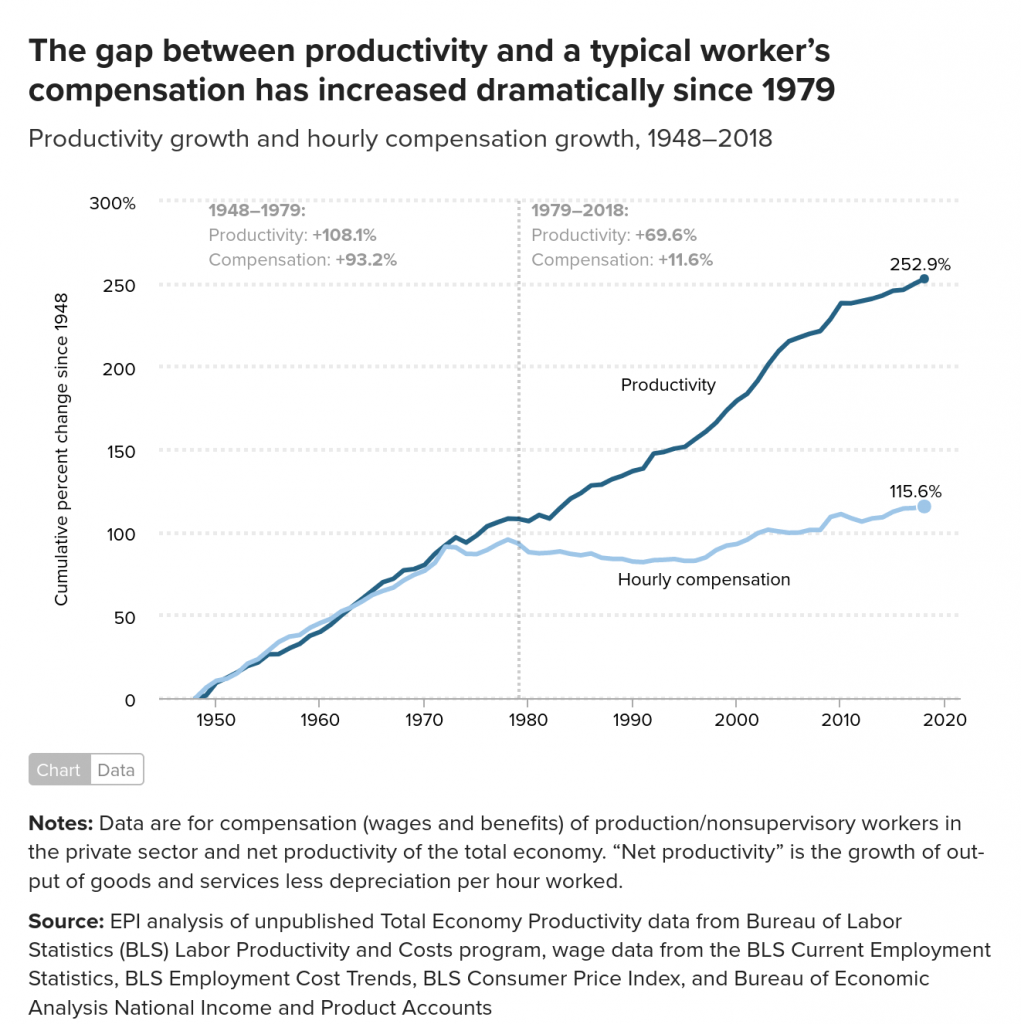
To speak further on capitalism and its ails, of which there are many, would be left for future writings. Hopefully this serves as an introduction to why capitalism needs replacing, but surely more will be written on this topic on this website. For now we need to analyze why socialism is the alternative system to capitalism and why it is socialism that does not suffer the same pitfalls. I conclude this section with a graph of productivity in relation to inflation-adjusted wages from 1948-2018 produced by data from the United States Bureau of Labor Statistics and presented from the Economic Policy Institute.
Socialism
Karl Marx created the economic system of socialism through several of his writings during the mid-1800s. Karl Marx deduced this Tendency of the Rate of Profit to Fall and did so by acknowledging the true nature of capitalism was in the relationship of commodities to other commodities. Capitalism fundamentally needs to remove the human from the equation. Profit is the motivator for action and profit is used to acquire the means of making more profit in an endless loop. Humans are removed from the process and in fact are often reduced to their ability to create more profit. While Marx, and many Marxists, would disagree that Marxism is in some way cosmopolitan, humanist or normatively concerned with the ‘good’, Marx’s observations fundamentally begin with the dehumanizing aspects of capital. By removing humans from the equation, social relations become how commodities relate to other commodities. How money can be used to acquire goods that can be used to acquire other goods.
Because of capitalism’s profit based motivation the pursuit of profit fundamentally leads to less profit long term and causes great wealth inequality; capitalism is not a longterm mode of production conducive to the advancement of human beings. Marx does recognize capitalism’s short term value. In fact in many ways, Marx is an ardent capitalist. Marx believes the development capitalism provides is irreplaceable and absolutely necessary for any transition to socialism. Marx finds that capitalism increases education of the mass population, their life expectancy, their general wellbeing and happiness until such a point that productivity begins to outpace wages. Capitalism brings with it literacy and healthcare and democracy and all facets of things that increase the general objective quality of life. But once capitalism begins to reach its pinnacle it degrades this quality of life in exchange for profits. Profits that are made for the sole purpose of profit-making. A commodity, money, is maximized for the sake of acquiring other commodities, goods, without relation to the human. It is at this point that capitalism has outlived its usefulness. There is an open debate about when or if we have reached exactly this point, but many believe we’ve long since achieved this state of late-stage capitalism. Martin Luther King Jr. said in a letter to his wife in 1952 that, “So today capitalism has out-lived its usefulness.”
The queerness of capital is in the fact that these good have value simply because humans have done something to these items. We’ve covered our bowl example but often times handmade bowls still are worth ‘more’ than bowls manufactured in an industrial process. A painting sells for more when it is an original done by the artist than a digital reprint no matter how good the replica. Even that digital reprint is only worth something because a human made a computer produce it and that humans want to purchase it. Yet in capitalism a perversion occurs in that the consumers rarely know the producers of the vast majority of goods that we consume. When you buy a bowl at Walmart you can never know where the clay came from or who mined that clay, or who transported the clay to the bowl factory, or who unpackaged that clay onto a usable palate or who took that clay and put it in the mold machine, or who put that molded clay into the kiln, or who took that fired bowl and put it into a machine to finish it and paint it, or who loaded the finished bowls onto the truck for delivery, or who unpacked that truck at the warehouse, or who prepared the packaged bowls for delivery to the Walmart from the warehouse, or who stocked the bowls onto the shelf. Even if you could know some of the people in that chain, it is likely many, many people were involved at each step or even more in the countless steps I’m sure I failed to enumerate.
Yet, that bowl is only worth the price that it is due strictly to the humans involved in its creation along every single step of the supply chain. The value of that bowl is tied directly to the fact that human beings did something to make it usable along the way. But, being unable to connect to the humans involved in creating this object obfuscates them from the process and means that only the bowl is left with a sticker price alienated from the humans that gave it this value. In the end, the bowl has no value in the form of humans relating to other humans but only has value in the relation of the bowl as a commodity to the money it can be exchanged for (the money being only valuable for its purpose of purchasing commodities).
This alienation is what causes the bowl to lose all human value. It’s the same thing that allows us to litter without care, not just for the damage to the environment but the failure to remember, and the impossibility to know, all of the people involved in the creation of that item. The birthdays missed, the lives lost of the workers that toiled to create for you this object that ultimately is devoid of that human value in our minds when we discard it carelessly. That in some hearth, deep within each item, all items are artisanal before capitalism perverts it. But, we don’t need to adjudicate capitalism and socialism solely on such normative levels. Marx shows that capitalism has a fundamentally materialist, scientific flaw that can be mathematically shown to puncture capitalism’s very core goals. The Tendency of the Rate of Profit to Fall and the failure of wages to match productivity. So what is the solution?
Socialism is simply an economic system in which the workers own the means of production and the concept of profit is nonexistent. Now socialism is every bit as broad as, if not more broad than, capitalism. While Libertarians have a different view of capitalism than Republicans, who have a different view of capitalism than Democrats, they are all inherently believers and defenders of a capitalist system. Socialism comes in an impossible to list number of forms and has its own set of parties and philosophies and believers that vary just like those in a capitalist society. Marx explicitly views socialism as a democratic system in which workers share directly in what it is they produce.
Generally there are two forms of this. The first are co-ops, where the workers themselves own the means of the company they work for. 100% of the ‘shares’ of this company are equally distributed amongst the laborers that work there. Decisions on purchasing, manufacturing, selling points, raises etc. are decided democratically amongst the employees. Any excess value generated is invested directly into the workers in the forms of profit-sharing, bonuses, advancements to the work place. From each according to their means to each according to their production. If a factory is more advanced than another factory the workers of the more advanced factory directly receive all benefits of this. Unlike what you may be familiar with otherwise, Marx does not innately support an equality of outcomes but rather an equality of opportunity. Each laborer has an opportunity to achieve what they like and they benefit directly from the outputs of their labor.
During such time period Marx demands a forced reallocation of wealth in which the capitalists who had benefited from the exploitation are relieved of their ownership of the means of production and are taxed at a rate of 100% above some level of income. This serves to elevate those who have been exploited by the previous system and levels the playing field so an equality of opportunity becomes possible. It is conceivable that depending on the method of this socialist revolution that these capitalists could return to the labor force on an equal playing field with all others. Despite the overly democratic nature of this system, Marx refers to it as the ‘Dictatorship of the Proletariat’ as it is the laborer-working class (the proletariat) that is now in power (it’s a democracy and the laborers by necessity vastly outnumber any other class). These actions can occur via the state apparatus or solely by a simultaneous workers movement in all sectors of industry thus allowing this sort of action to be either statist or anarchist.
The other dominant flavor is state socialism. While still democratic it is state mandated policy that industries be publicized and/or democratized. The state and various localities then take control of these businesses and redistribute their profits amongst both the workers of these industries and the communities in which they reside. In many cases businesses related to human needs are publicized such as agriculture, utility companies (power, water, sewage, garbage, internet, television, radio), clothing manufacturers, housing developers etc. Things related to food, water, shelter, healthcare, infrastructure. Other industries may also be controlled by the state or be forced to democratize the workplace via a co-operative. Meanwhile, the state itself is to remain a democratic body with a decentralized power structure and multiple competing parties. Marx does not suggest, and in fact directly opposed, that there should be any dominant single party dictatorial structure. Many facets of any Western democracy would still exist nearly entirely as they do today, simply the major economic mode of production would shift.
The biggest uniting themes in socialism are that individuals receive their basic needs met, ‘from each according to their ability to each according to their needs’ and that workers own the means of production. The nationalizing of industries is what is referred to by the phrase ‘abolish private property.’ Socialism never suggests you have no right to personal property such as your home, your vehicle, your phone, your computer. Socialism considers personal property and public property. Personal being your own possessions and public being the means of production. This does not mean you cannot own a paint gallery that is your own personal space. It does not mean that you cannot own a tattoo parlor or even a bakery. It does mean that you cannot own a factory that makes t-shirts or airplanes. You can acquire some t-shirts and apply custom designs or make your own t-shirts of custom fabrics. But you cannot exchange those for commodities that allow people to access means of production. Someone may give you a ladder in exchange for a t-shirt but you cannot receive money or ration tickets or the deed to a factory in exchange for your t-shirt. You may also, of course, choose to simply give your t-shirt away.
Socialism is not when the government does things. Taxation is not socialism. Socialism is not a tax on carbon emissions. Socialism is when the workers own the means of production and every individual is guaranteed basic needs such as healthcare, housing, food, clothing, education. Socialism is not about mandating everyone have everything identical. Socialism is ensuring equality of opportunity (equality of access) not equality of outcomes. In some cases it may mean that you are required to do x hours of work on the community farm or digging a ditch for new water pipes. Just as children are expected to do chores around the house or farm. With collective labor these requirements may be minimal and seeing as you have no obligations to make profit to have your home, food, clothing, health care there may be minimal expectations for you to work otherwise.
So socialism is just a bunch of freeloading? No. Capitalism is not the basis of human nature. Humans existed for thousands of years with no capitalism. Communities exist today that do not practice capitalism (Amish, Hutterites, Native populations etc.). In fact it’s just another common misconception that socialism is all about freeloading. Marx is adamant that the actual human condition is to want to work. It’s why capitalism is an easy trap. Humans innately want to do work and in fact that desire to work is what separates humans from animals, according to Marx. But instead of having to work to survive, humans should be free to choose how they wish to work to reach their true potential. If everyone was given the freedom to do as the please with their time every one would have a chance to reach their own maximal potential. This is true liberation and what Marxists call human emancipation. Emancipatory politics are those that enable us to be at our freest possible with the time we spend on Earth. The goal of socialism is human emancipation.
What’s communism?
Marx offers a distinction between socialism and communism but regrettably uses the two terms rather interchangeably. Modern Marxists recognize this distinction and generally stick to it. Socialism is the period of time in which the workers own the means of production and the ‘dictatorship of the proletariat’ is in place. The forced redistribution of wealth to make the system equitable. Communism is the step after that, which Marx died before he could ever offer great specifics on or a gameplan to get to.
Marx suggests that communism is a global stateless society in which all human peoples are united. It is what he viewed as an inevitable endpoint of human evolution. That when we get to the point where socialism has redistributed wealth and everyone has achieved an equality of opportunity and workplaces have been democratized in the same form as our government there’ll no longer be a need for the ‘state.’ People will have their basic needs met and because no one can capture the means of production for themselves all incentives for this behavior will decay and disappear. The state apparatus that protects the capitalists, that had to be co-opted for the usage of the workers, that maintained a centrally planned economy to eradicate poverty would no longer be needed. With poverty defeated, profit eliminated, equal access assured, humanity will have simply evolved past the need for class conflicts that divided us. This doesn’t mean no crime, it doesn’t explicitly mean utopia, it just means the functions of the state are moot. Communities will still organize and govern themselves and plan their actions. Globally we can still leverage our communal resources to organize exchanging necessities among one another. But the need for national boundaries and militaries and states would be gone.
Marx is not clear on how this happens or how we get here. Marx does not lay out specifics of what institutions would need to exist in a time of communism. Marx is relatively clear that communism is the end goal that socialism strives for and that necessarily every socialist is a communist and vice versa. Marx also specifically warned about the dangers and futility of ‘socialism-in-one-country’ and suggested that all workers of the world need to enact socialist change near-simultaneously. Later Marxists and Socialists like Lenin, Stalin, Guevara, Castro, Mao and others would suggest the feasibility of socialism in one country. The point is up for debate among leftists today. But given the general utopic nature of communism it is hard to imagine anyone expressly against its principles. People may doubt its feasibility or question its alleged implementations around the globe thus far but the true definition of communism is hard to disagree with. It’s Earth from Star Trek.
How do we get there? Why hasn’t it worked?
The biggest criticisms of socialism/communism are often in its possibility or its past attempts. It is worth pointing out that several countries have tried implementing socialism to various degrees of success and that many Western democracies have implemented elements of ‘socialistic’ policies to various degrees of success. There are many answers that could be given and the time to cover them all, especially in this already longwinded document, is insufficient. We will review some of the highlights.
Socialism lies fundamentally outside of the classical liberal conception of a capitalist system. Socialism is centrally about giving up perceived individual freedoms to achieve the ultimate individual freedoms. By working for collective measures we share in individual bounty. The same way it is hard for you to raise your wage on your own, collectively bargaining with a union that is appointed to negotiate on your behalf gets you higher wages. You have given up the freedom to bargain your wage yourself but you wind up getting a higher wage anyway. Similarly, you cannot alone elect a representative to office but by collectively acting with likeminded individuals to form political parties allows you the opportunity to get the representation you desire. By giving up your chance at being a dictator you can instead achieve desired outcomes by working with others in a democracy. The idea of sacrificing perceived freedoms to achieve greater freedoms is a hard concept to grasp.
Additionally, the path to socialism necessitates the removal of the capitalists. Capitalists spend time and money to amass their ever-growing fortunes and the prospect of being separated from it is deeply troubling. Even if the end goal is better for them and others. Thus, capitalism expend enormous amounts of money to preserve itself. This happens via propaganda, political spending, lowering wages and such so that workers cannot credibly challenge the system.
This capitalist behavior is not always cognizant. After all, the danger in capitalism is that it is self-reaffirming and self-reifying. Capitalism makes capitalism work. Everything becomes a product, everything becomes a profit opportunity and markets move on their own independent of the individuals. Capitalism invades the news, schools, healthcare and everything else. Its tendrils are deep. This happens the moment we ask kids what their dream jobs are when they grow up or give them an allowance for chores or help them set up a lemonade stand. We are ingrained with the idea that all of your actions must lead to profit so that way you can use your profit to acquire more profit. Such that the profit you acquire leads to such an immense wealth that you can leave it for your children who do not have to worry about money. Ultra capitalism serves as an escape from itself. People frequently want to make as much money as they can so they never have to worry about money again. But we always have to worry about money. Time wasted is a dollar lost, after all.
This behavior is not done by some shadow council. There’s not some cabal of evil capitalists out there forcing us all to adhere to capitalist dogma. In fact it’s far more insidious. Capitalism was woven into the fabrics of government and social life so deeply, as a result of the great gifts capitalism did give us, that we have trouble thinking in non-profit terms. Capitalist propaganda is deep. It’s why we refer to the NBA walkout over the Jacob Blake shooting as a boycott and not a strike. Class consciousness is buried deep. The illusion that anyone can be a billionaire under capitalism obscures the fact that wealth breeds wealth and capitalism makes the rich richer at a rater that dramatically outpaces the earnings of the poor. People are born, live and die without the capacity to imagine a system outside of capitalism. To think in non-monied terms. To think in non-profit values. To reintroduce the human into humanity.
So how do we get there? It’s hard. And it hasn’t worked in the past simply because it is hard. Corruptions and co-optations of movements by those who were misguided or intentionally illfull are to blame. Combating a global economic system that has managed to infect every aspect of social life is among the greatest tasks humanity could ever tackle. A collective building of a humanity sized ark to ride out the capitalist flood. But praxis is any means of acting on a posited theory. And many small planks of wood will be needed to build the ark. Thinking of the toils of the humans who made your pen or pencil. Educating your friends, family, and coworkers of the ails of capitalism. Daring to dream of a future beyond waking up every day to work a job you hate until you die. Walking arm and arm with your fellow laborer against the powerful capitalists instead of fighting with one another over which capitalist you prefer. All acts of praxis. And through praxis, change can be had. It does not have to be an impossible dream. If only the workers of the world unite.
-marx
Be the first to comment on "What is Socialism?"